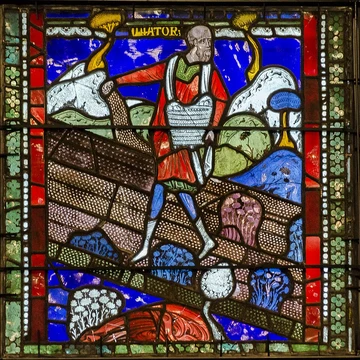
Latin translations of the 12th century
Scholars translated Arabic and Greek works into Latin, reviving European learning.

Latin translations of the 12th century were spurred by a major search by European scholars for new learning unavailable in western Europe at the time. Their search led them to areas of southern Europe, particularly central Spain and Sicily, which had recently come under Christian rule following reconquest in the late 11th century. These areas had been under Muslim rule for a considerable time and still had substantial Arabic-speaking populations, making them intellectually attractive and accessible to Latin scholars.
- era
- 12th century
- primary_regions
- Central Spain and Sicily
- main_languages_translated_from
- Arabic and Greek
- key_center
- Toledo, Spain
- focus_of_translations
- Scientific, philosophical, and religious texts
Lore & Background
There, seeing an abundance of books in Arabic on every subject, and pitying the poverty he had experienced among the Latins concerning these subjects, out of his desire to translate he thoroughly learnt the Arabic language. Translations were produced throughout Spain and Provence. Plato of Tivoli worked in Catalonia, Herman of Carinthia in Northern Spain and across the Pyrenees in Languedoc, Hugh of Santalla in Aragon, Robert of Ketton in Navarre, and Robert of Chester in Segovia. The most important center of translation was the great cathedral library of Toledo. Sicilians generally translated directly from Greek, but when Greek texts were not available, they would translate from Arabic.
Reader's Guide
The Latin translations of the 12th century were a pivotal movement that reintroduced ancient Greek and Arabic scientific, philosophical, and medical knowledge to Western Europe. By drawing on the accumulated knowledge of Arabic-speaking scholars in recently reconquered Spain and Sicily, translators such as Gerard of Cremona, Plato of Tivoli, and Robert of Chester made works like Ptolemy's Almagest, al-Khwarizmi's Algebra, and the Qur'an available in Latin for the first time. This influx of new ideas helped spur the development of scholastic thought and the rise of universities throughout Europe. Unlike the later Renaissance focus on classical literature, 12th-century translators sought scientific and philosophical texts, with some attention to religious works. Their efforts laid the groundwork for the intellectual revival of the High Middle Ages, bridging cultures and preserving knowledge that might otherwise have been lost to Latin Christendom.
Did You Know?
- Gerard of Cremona traveled to Toledo specifically because he could not find a Latin copy of Ptolemy's Almagest.
- Sicily's trilingual bureaucracy made it an ideal place for translations, and Sicilians often translated directly from Greek.
- Constantine the African, a Christian from Carthage who studied medicine in Egypt, translated medical works from Arabic at the monastery of Monte Cassino in Italy.
The Reconquest and the Translation Hubs
The late 11th and early 12th centuries saw a dramatic shift in the political map of southern Europe that would reshape the intellectual landscape of the Latin West. These reconquests did not erase the cultures they displaced. In central Spain, substantial Arabic-speaking populations remained alongside Latin-speaking communities, creating a rare environment where two rich scholarly traditions coexisted. This multilingual infrastructure made it a natural crossroads for the exchange of manuscripts and ideas. The Crusader Kingdoms, by contrast, contributed very little to translation work due to their small populations. Spain, with its side-by-side Latin and Arab cultures, proved ideal for Arabic-to-Latin translation, while Sicily's Greek-speaking character made it more productive for direct Greek-to-Latin work.
The Translators and Their Masterworks
The 12th century produced a remarkable cast of translators whose work bridged civilizations. Constantine the African, a Christian originally from Carthage who had studied medicine in Egypt, settled as a monk at Monte Cassino and rendered numerous medical texts from Arabic, including al-Majusi's Complete Book of the Medical Art, works attributed to Hippocrates and Galen as adapted by Arabic physicians, and treatises by Isaac Israeli ben Solomon and Ibn al-Jazzar. In Sicily, Henry Aristippus translated Plato's Meno and Phaedo, while an anonymous student at Salerno carried out the Latin rendering of Ptolemy's Almagest and several Euclid works. Admiral Eugene of Sicily used his command of three languages to translate Ptolemy's Optics. Gerard de Sabloneta brought Avicenna's Canon of Medicine and al-Razi's Almansor into Latin. James of Venice, likely after years in Constantinople, translated Aristotle's Posterior Analytics in the mid-12th century, completing the full Aristotelian logical corpus in Latin for the first time.
A Long Silence and Slow Awakening
For centuries before the 12th century, ancient Greek philosophical thought was virtually absent from Western Europe. St. Jerome had expressed open hostility toward Aristotle, and St. Augustine showed little appetite for philosophy beyond applying logic to theological questions. Only a handful of monasteries possessed Greek works, and even fewer bothered to copy them. A brief flowering occurred during the Carolingian Renaissance, when the Anglo-Saxon monk Alcuin and his colleagues reintroduced certain Greek ideas. Yet after Charlemagne's death, intellectual life in the West slid back into decline. For roughly two centuries, philosophical development was minimal, with only a few figures like Gerbert of Aurillac keeping Boethius' commentaries on Aristotle alive. The 12th century marked a turning point: scholastic thought began to take shape, and universities sprang up across Europe. These institutions gathered whatever Greek thought had survived through the centuries and became forums for debating the new ideas arriving through translations from Arabic. The very existence of these universities created institutional demand for the texts that translators were producing.
What the Translators Chose to Render
Unlike Renaissance humanists who gravitated toward classical literature and history, 12th-century translators prioritized scientific and philosophical texts, with religious material a secondary concern. Their output spanned medicine, mathematics, natural philosophy, and theology. Medical translations dominated in many cases: Constantine the African rendered works on fevers, diets, urine, melancholy, the stomach, elephantiasis, and forgetfulness. Mathematical and astronomical texts, such as Ptolemy's Almagest and Euclid's geometric works, were brought into Latin from both Greek and Arabic sources. The religious dimension included renewed interest in translating the Greek Church Fathers into Latin, efforts to render Jewish teachings from Hebrew, and attention to the Qur'an and other Islamic religious writings. Some Arabic literary works also found their way into Latin. This broad scope reflected a generation of scholars hungry for knowledge that had been unavailable in the West, seeking not merely familiar classical texts but the accumulated scientific and philosophical achievements preserved and advanced in the Arabic-speaking world.
Frequently Asked Questions
What were the Latin translations of the 12th century?
They refer to a wave of scholarly work in which European intellectuals rendered Arabic and Greek scientific, philosophical, and religious texts into Latin. The movement was driven by a hunger for knowledge that was simply unavailable in western Europe at the time.
Where did the 12th-century Latin translations primarily take place?
Central Spain and Sicily were the main hubs, especially after Christian reconquest in the late 11th century brought those regions back under Latin rule. Toledo in Spain became the standout center, partly because sizable Arabic-speaking communities still lived there and made source material accessible.
What kinds of texts were translated during the 12th-century Latin translation movement?
The focus was on scientific, philosophical, and religious works originally composed in Arabic and Greek. These were texts that western European scholars had little or no access to before the translation wave began.
Why are the Latin translations of the 12th century considered important?
They effectively revived and expanded European intellectual life by reintroducing classical and Islamic knowledge to the Latin West. Without this transfer, the later flowering of medieval universities and scholastic thought would have lacked much of its foundational material.
More in Medieval Europe 1-24
Elsewhere in the Medieval Europe universe
Spotted an error? Know more?
This is a living reference — every entry is fact-audited, and reader corrections feed straight into our audit queue. Suggest an edit · See this site's audit record