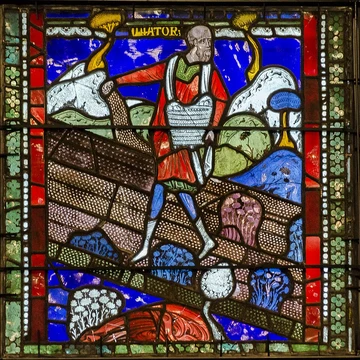
Medieval renaissances
Three medieval cultural renewals, first named in the 19th century.

The medieval renaissances were periods of cultural renewal across medieval Western Europe, occurring in three phases: the Carolingian Renaissance (8th and 9th centuries), the Ottonian Renaissance (10th century), and the Renaissance of the 12th century. The term was first used by medievalists in the 19th century, by analogy with the 15th and 16th century Italian Renaissance, marking a break with the dominant historiography that saw the Middle Ages as a Dark Age. The concept has always been debated, particularly regarding how widespread such renewal movements were and the validity of comparing them with the later Renaissance.
- field
- Cultural, educational, and intellectual history
- known_for
- Three phases of cultural renewal: Carolingian, Ottonian, and 12th-century
- first_use_of_term
- 1830s by Jean-Jacques Ampère
Lore & Background
The concept of medieval renaissances emerged in the 19th century alongside medieval studies. Jean-Jacques Ampère first employed the term in the 1830s, referring to a Carolingian Renaissance and a 12th-century renaissance, countering the prevailing view of the Middle Ages as culturally regressive, as advanced by Jules Michelet. Although occasionally adopted by other 19th-century authors, the concept was not widely applied until the 20th century, beginning in the 1920s.
Reader's Guide
The medieval renaissances are significant as they represent periods of cultural, educational, and intellectual revival within the Middle Ages, challenging the earlier historiographical notion of a Dark Age. These phenomena are not portrayed as widespread, coherent developments across medieval Western society; only the 12th-century renaissance coincides with major economic and social transformations. They lack the highly secularized humanism of the 16th-century Renaissance and remain tied to ecclesiastical and Christian societal reformatio. Comparisons with the later Renaissance require caution, as medieval renaissances strengthened monastic and episcopal schools, contrasting with the later separation of science and teaching. The term has also been applied to other eras, such as a Vandal renaissance in 6th-century Africa, an Isidorian renaissance in 7th-century Visigothic Spain, and a Northumbrian renaissance in the 8th century, reflecting the enduring presence of classical references throughout the Middle Ages.
Did You Know?
- The term 'medieval renaissances' was first used by medievalists in the 19th century, by analogy with the Italian Renaissance.
- Jean-Jacques Ampère first employed the term in the 1830s, referring to a Carolingian Renaissance and a 12th-century renaissance.
- The concept has always been a subject of debate and criticism, particularly on how widespread such renewal movements were.
More in Medieval Europe 1-24
Elsewhere in the Medieval Europe universe
Spotted an error? Know more?
This is a living reference — every entry is fact-audited, and reader corrections feed straight into our audit queue. Suggest an edit · See this site's audit record